For decades, Indian cricket was known for producing world-class batsmen and exceptional spin bowlers. Fast bowling, however, was often considered India’s weakest link. Overseas tours exposed this limitation, with Indian pacers struggling to consistently trouble batsmen on fast, bouncy pitches. That narrative has completely changed over the last decade. Today, India possesses one of the strongest fast-bowling ecosystems in world cricket, capable of dominating opponents in every condition.
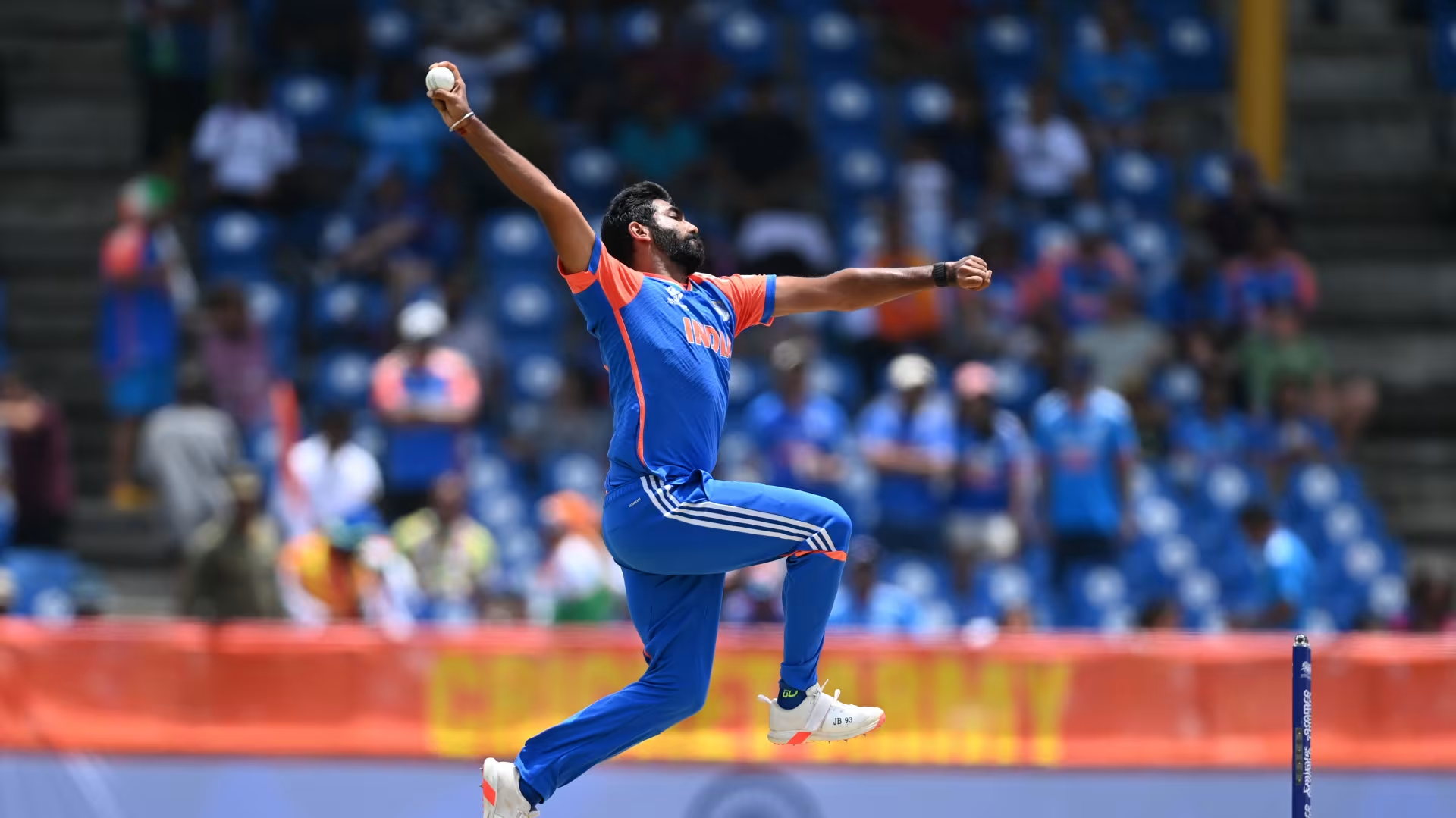
At the heart of this transformation stands Jasprit Bumrah—a once-unorthodox youngster who evolved into arguably the finest all-format fast bowler of his generation. His ability to swing the new ball, reverse the old ball, execute deadly yorkers, and deliver under pressure has made him India’s bowling spearhead.
However, every era eventually transitions. Bumrah has carried India’s pace attack for years, but workload management, injuries, and the natural progression of a cricketing career have raised an important question:
Who will lead India’s fast-bowling revolution after Jasprit Bumrah?
The answer may not lie in a single player. Instead, India appears to be building an exciting generation of fast bowlers capable of sharing responsibility and keeping the nation’s pace legacy alive.
Jasprit Bumrah: The Gold Standard
Before discussing the future, it’s important to understand the benchmark Bumrah has established.
Few bowlers in modern cricket combine accuracy, pace, intelligence, and adaptability as effectively as Bumrah. His unique action initially drew criticism, but it eventually became one of cricket’s greatest strengths. Whether defending a small total in a T20 match or bowling long spells in a Test overseas, Bumrah has repeatedly delivered when India needed him most.
His greatest contribution extends beyond statistics. He changed India’s mindset. Fast bowling was no longer merely about containment—it became a genuine match-winning weapon.
The next generation must now build upon the foundation he helped create.
Mohammed Siraj: The Experienced Leader
Among India’s current pace bowlers, Mohammed Siraj appears best positioned to assume greater responsibility.
Siraj’s rise from humble beginnings to becoming India’s strike bowler is one of cricket’s most inspiring stories. Initially viewed as an aggressive but inconsistent fast bowler, he has transformed into a disciplined performer capable of exploiting helpful conditions while maintaining relentless pressure.
His biggest strengths include:
- Excellent seam movement
- Ability to bowl long spells
- High energy and aggression
- Improved control with the new ball
In Test cricket, Siraj has already proven himself in Australia, England, South Africa, and at home.
Although he may not possess Bumrah’s extraordinary versatility, Siraj has the experience and temperament to lead India’s pace attack whenever required.
Arshdeep Singh: India’s Left-Arm Advantage
Every great bowling attack benefits from variety.
India has traditionally struggled to produce high-quality left-arm fast bowlers, making Arshdeep Singh particularly valuable.
Initially recognized as a T20 specialist, Arshdeep has steadily improved his ability to swing the new ball while developing exceptional control at the death.
His strengths include:
- Left-arm angle creates different challenges for batsmen.
- Consistent yorkers.
- Clever slower balls.
- Calmness in pressure situations.
If he continues improving in longer formats, Arshdeep could become an all-format asset and provide India with a unique bowling dimension.
Prasidh Krishna: Pace and Bounce
Standing well over six feet tall, Prasidh Krishna brings something India has rarely possessed—steep bounce generated from height.
Modern Test cricket rewards bowlers capable of extracting awkward lift even on relatively flat surfaces.
Prasidh’s key advantages include:
- High release point
- Extra bounce
- Speeds consistently above 140 km/h
- Ability to trouble tall and short batsmen alike
His biggest challenge has been fitness. If injuries remain under control, he could become India’s first-choice fast bowler in overseas conditions.
Harshit Rana: India’s Aggressive New Face
Among India’s newest fast-bowling prospects, Harshit Rana has attracted considerable attention.
Unlike many young bowlers who rely solely on raw pace, Harshit combines aggression with tactical awareness.
His strengths include:
- Fast, hard lengths
- Natural bounce
- Fearless attitude
- Ability to bowl in difficult phases
More importantly, he enjoys bowling to attacking fields instead of simply containing runs.
India’s management has increasingly shown confidence in young players willing to challenge world-class batsmen, and Harshit fits that philosophy perfectly.
Akash Deep: The Silent Performer
Not every fast bowler arrives with massive hype.
Akash Deep has quietly built a reputation as one of India’s most dependable domestic performers before earning opportunities at the highest level.
His strengths include:
- Excellent seam position
- Consistent accuracy
- Ability to move the ball both ways
- Strong work ethic
He may never become the fastest bowler in the squad, but teams often require dependable bowlers capable of maintaining pressure for long periods.
Mayank Yadav: The X-Factor
Few young Indian fast bowlers have generated as much excitement as Mayank Yadav.
His raw pace immediately captured attention.
Consistently bowling above 150 km/h, Mayank possesses genuine express speed—something India has historically lacked.
His strengths include:
- Extreme pace
- Sharp bouncers
- Heavy ball
- Ability to surprise experienced batsmen
However, speed alone is not enough.
To become Bumrah’s long-term successor, Mayank must improve:
- Fitness
- Workload management
- Control
- Tactical consistency
If those areas develop, India could possess one of the world’s most feared fast bowlers.
The Importance of India’s Domestic System
India’s fast-bowling revolution is not happening by accident.
Several factors have contributed:
Better Fitness Programs
Modern Indian cricketers are significantly fitter than previous generations.
Strength training, recovery science, nutrition, and injury prevention have all improved dramatically.
IPL Exposure
The Indian Premier League allows young bowlers to:
- Bowl against international superstars.
- Learn from legendary coaches.
- Handle pressure situations.
- Develop death-bowling skills.
Many current Indian pacers accelerated their development through IPL experience.
Better Pitch Preparation
Domestic cricket now offers greater pitch variety.
Fast bowlers regularly encounter:
- Green surfaces
- Hard wickets
- Red-ball challenges
- White-ball pressure situations
These experiences prepare them for international cricket far better than before.
Will India Need One Bumrah or Many Leaders?
Perhaps the biggest mistake would be expecting one player to replace Jasprit Bumrah.
Players like Bumrah appear only once in a generation.
Instead of searching for a direct replacement, India should build a collective pace attack where responsibilities are shared.
Imagine an attack consisting of:
- Mohammed Siraj’s experience
- Arshdeep Singh’s left-arm swing
- Mayank Yadav’s express pace
- Harshit Rana’s aggression
- Prasidh Krishna’s bounce
Such a combination could become even more versatile than relying on a single superstar.
Challenges Ahead
Despite India’s impressive pace depth, several challenges remain.
Injury Management
Fast bowling is physically demanding.
Managing workloads will be crucial to ensuring young bowlers enjoy long international careers.
Transition Across Formats
Success in T20 cricket does not automatically translate into Test cricket.
Young bowlers must develop patience, consistency, and tactical awareness for longer formats.
Overseas Consistency
India’s future leaders will ultimately be judged by performances in:
- Australia
- England
- South Africa
- New Zealand
Winning overseas Test series remains the highest standard for any pace attack.
The Future Looks Bright
Indian cricket has entered an era where producing quality fast bowlers is no longer a rarity—it’s becoming the norm. The system now identifies talent early, provides world-class coaching, and offers opportunities through domestic cricket and the IPL. This pipeline has created a healthy competition that benefits the national team.
While Jasprit Bumrah’s influence on Indian cricket is unmatched, his legacy is bigger than wickets and match-winning spells. He has inspired an entire generation to believe that Indian fast bowlers can dominate the world’s best batsmen in any condition. That belief is now deeply rooted in the country’s cricketing culture.
The next leader may be Mohammed Siraj with his experience, Mayank Yadav with his raw pace, Arshdeep Singh with his left-arm variation, or perhaps a young pacer yet to make his international debut. Regardless of who eventually carries the torch, India’s pace-bowling future appears secure.
The fast-bowling revolution is no longer a passing phase—it is the new identity of Indian cricket. And while replacing a once-in-a-generation bowler like Bumrah is nearly impossible, India has built something even more valuable: a conveyor belt of talented pacers ready to lead the next chapter. The question is no longer whether India will have quality fast bowlers after Bumrah, but which of these rising stars will step forward to become the next face of India’s pace attack.